Author: Zhao Yantao Editor: Lu Cong
If we try to understand why Xi Jinping keeps concentrating power, breaking the term-limit conventions that had taken shape in the past, and even moving toward long-term rule, then I believe there is one question worth serious reflection:
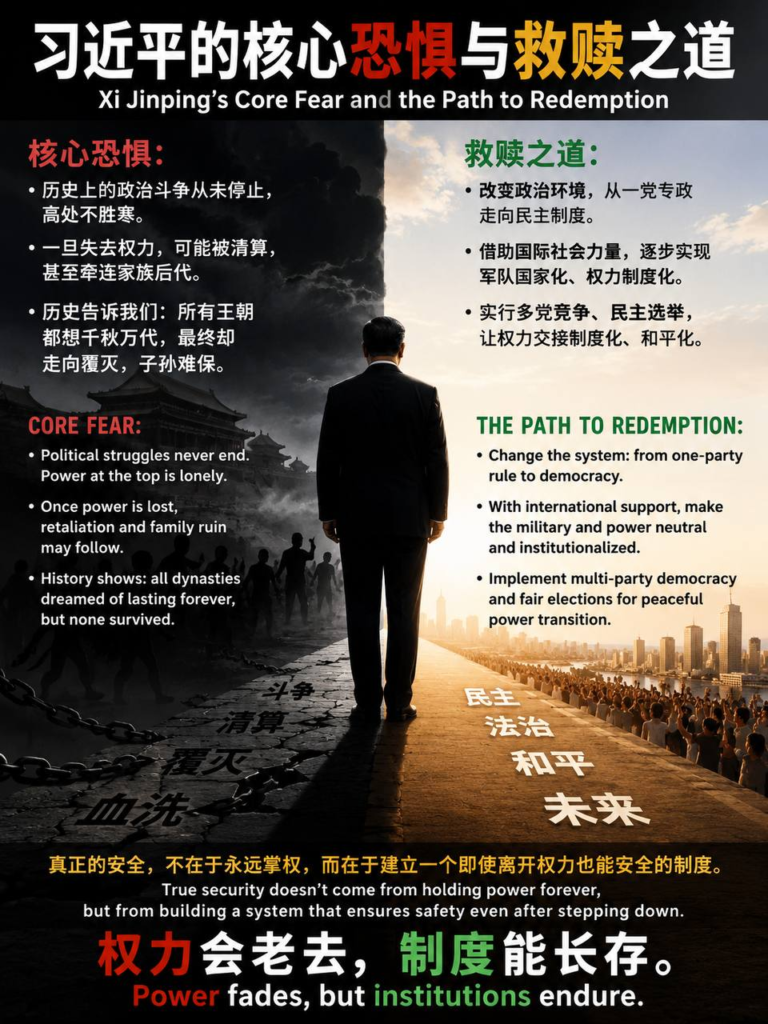
What exactly is it that Xi Jinping truly fears?
This is not necessarily merely a craving for power itself; more likely, it is a deep sense of insecurity arising from the political environment.
China's several thousand years of political history have one very striking feature: power is highly concentrated, and political struggle generally unfolds around individuals, factions, and political blocs. Once a person stands at the pinnacle of power, the greater the power he has acquired, the greater may also be the risks he faces after he leaves power.
Seen from this angle, long-term rule may give rise to a particular political logic:
Only by continuing to hold power can one protect oneself; only by controlling the entire political system can one prevent a future political reckoning.
In fact, academic research has also noted that in the Xi Jinping era political power in China has clearly concentrated toward the top leader, and that the mechanisms of term limits, retirement, and relatively institutionalized leadership succession that had taken shape since reform and opening up have undergone major change. In 2018, China abolished the constitutional limit that the President may not serve more than two consecutive terms. (Cambridge University Press)
But the question is:
Can power really bring permanent security?
Chinese history has already given the answer.
Nearly every dynasty, at the time of its founding, hoped that its rule would last for a thousand autumns and ten thousand generations; every supreme ruler, too, may have hoped that his own family would hold power for a long time to come.
But history never develops according to any individual's plan.
The Qin did not last for a thousand generations; nor did the Han, nor the Tang, nor the Ming — and neither did the Qing.
A ruler can expand his own power to its utmost limit, yet he cannot truly control history.
Therefore, I believe that what Xi Jinping truly needs to face is perhaps not "how to hold power forever," but rather:
how to build a system that, even after he leaves power, can guarantee the safety of himself, his family, and his entire political bloc.
This may be the true way out of the so-called "core fear."
Then, where does the path to redemption lie?
I believe the answer is precisely not to further strengthen personal power, but to thoroughly change the political environment that gives rise to this fear.
If a country establishes a truly stable constitutional system, judicial independence, checks and balances on power, open and transparent political procedures, and a mechanism for the peaceful rotation of parties in office, then a leader does not need to rely on lifelong rule to protect himself.
Because under a democratic system:
political failure is not failure in life, and losing power does not mean losing safety.
A person can be president today and an ordinary citizen tomorrow; a party can be in government today and in opposition tomorrow.
What such a system truly resolves is the deepest fear within political struggle —
"If I lose power, will I be retaliated against?"
Therefore, if Xi Jinping truly wishes to solve his own long-term security problem, I believe the path most worth considering is not to continue concentrating power in his own hands, but to use the political influence he now possesses to lead China through a peaceful institutional transition.
From long-term one-party rule, gradually toward genuine political competition;
From the supremacy of personal power, toward the supremacy of the constitution and the law;
From political struggle, toward institutional competition;
From transfers of power that depend on personal arrangements, toward peaceful transfers achieved through elections.
As for the relationship between the military and political power, it too should ultimately move toward nationalization, institutionalization, and non-partisanship, and the transfer of power should be completed by peaceful, gradual, and verifiable means, rather than problems being resolved through violent revolution or political reckoning.
This may be redemption in the true sense of the word.
It is not about letting one person hold power forever, but about letting a person still be able to obtain safety even after giving up power.
If one day China can build a modern political system that lets those in power dare to step down, lets opposition parties dare to stand for election, keeps the military from intervening in party struggles, and prevents the judiciary from becoming an instrument of political retaliation, then the political cycle of several thousand years in China — "the winner becomes king, and the loser comes to grief" — may finally truly come to an end.
Therefore, I believe that what Xi Jinping truly needs to overcome is perhaps not any particular political opponent.
It is a political fear that has continued for thousands of years:
the fear of being subjected to a reckoning after losing power.
And what can truly put an end to this fear is not power that is even more concentrated.
Quite the contrary —
it is to build a democratic system in which, even after losing supreme power, one can still exit safely.
This may be the way out for Xi Jinping personally, and also the way for China's political civilization to truly move toward modernization.