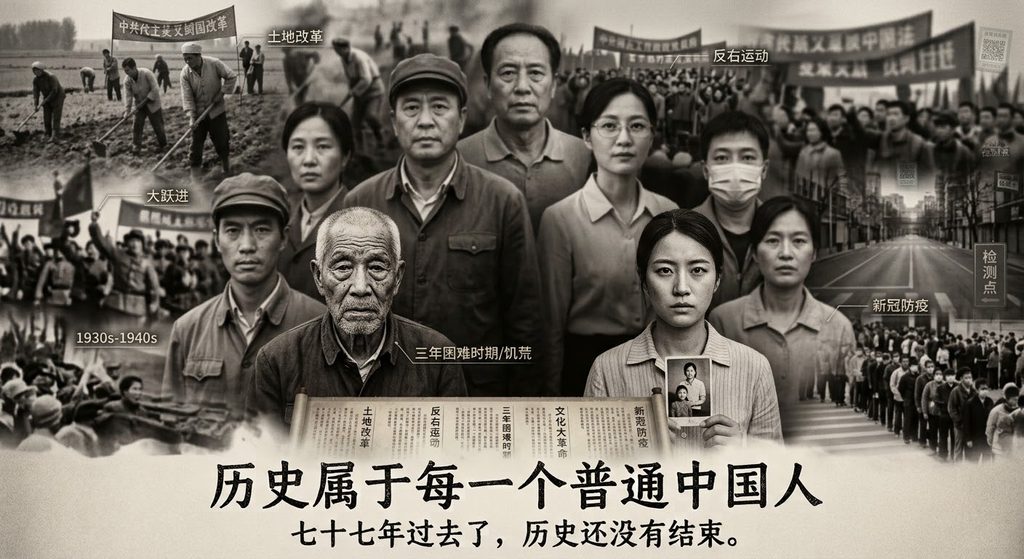
— From Political Movements, Famine, and the Cultural Revolution to Pandemic Lockdowns and the Concentration of Power
Author: Zhao Yantao Editor: Lu Cong
On October 1, 1949, the Chinese Communist Party proclaimed the founding of the People's Republic of China in Beijing.
Seventy-seven years have passed.
But if we are to understand everything that has happened in China since 1949, we cannot begin only in 1949.
We must take the timeline back to the period of the War of Resistance Against Japan.
During the War of Resistance Against Japan, the Chinese Communist Party established base areas in enemy-occupied territory such as North China, built up armed forces, and waged large-scale guerrilla warfare.
Guerrilla warfare placed military pressure on the Japanese forces, but at the same time, the areas behind enemy lines also became a major space for war and for Japanese reprisals.
Mopping-up operations, reprisals, and massacres — in the end, those who bore the enormous cost were not only soldiers, but also large numbers of ordinary Chinese civilians.
And for the Chinese Communist Party, the war of resistance was also an important historical stage in which it expanded its base areas, developed its organization, and enlarged its political influence.
At the same time, the Chinese Communist Party did not develop in complete isolation.
The Communist International and the Soviet Union long maintained political, organizational, economic, and military ties with and support for the CCP.
These international relations are likewise an important historical background for understanding how the Chinese Communist Party later came to power.
In 1945, the War of Resistance Against Japan ended.
The civil war between the Kuomintang and the Communists broke out again.
In 1949, the Chinese Communist Party took power over the whole country.
Then China entered a series of political movements of enormous scale.
Land Reform.
The Anti-Rightist Movement.
The Great Leap Forward.
The People's Communes.
The Cultural Revolution.
Family planning.
These movements profoundly changed the fates of countless ordinary Chinese people.
During the Land Reform, large numbers of landlords had their property confiscated and were subjected to struggle sessions and execution.
Class status began to become a major factor determining a person's fate.
After the Anti-Rightist Movement of 1957, large numbers of intellectuals were politically persecuted for expressing differing opinions.
Then came the Great Leap Forward.
Steelmaking by the whole people.
The People's Communes.
Grain output figures were falsely inflated at every level.
Political slogans replaced the laws of economics.
What finally occurred was a large-scale famine.
Scholarly research offers differing estimates of the exact death toll, but there is no doubt that this was a historical catastrophe that caused an enormous number of unnatural deaths.
In my own family, too, someone starved to death in that famine.
To others, it may be only a number in a history book.
To our family, it was a loved one who will never come back.
Then came the Cultural Revolution.
Struggle sessions.
House raids.
Armed factional fighting.
Political persecution.
Intellectuals came under attack.
Ordinary families were swept into political struggles.
And in some places, the violence reached almost unimaginable extremes.
In 1968, in Wuxuan, Guangxi, severe collective violence and killings took place, and even incidents of cannibalism occurred.
People were killed.
Corpses were dismembered.
There were even the horrors of human beings eating human beings.
This is not a work of fiction.
This is history that truly happened.
Later came the long-implemented family planning policy.
In the course of its coercive enforcement, some families endured immense suffering, and it also left long-term problems in the population structure.
Later still came the COVID-19 pandemic.
The pandemic itself was a public health crisis.
But the methods of governance adopted during the pandemic likewise deserve the judgment of history.
Citywide lockdowns.
Sealed lockdown controls.
Health codes.
Mass nucleic acid testing.
Round after round of testing for the entire population.
Some places even maintained normalized nucleic acid testing over the long term.
When nucleic acid testing became a necessary condition for maintaining a normal life, it also generated economic activity on an enormous scale.
Questions therefore arose:
Of such an enormous investment of public resources, how much was truly used to protect the people?
What kind of oversight should public finances be subject to?
And what kind of scrutiny should there be of the testing institutions, local governments, and the related chains of interest?
We cannot simply blame all fiscal problems on nucleic acid testing, nor can we directly say that the problems of the pension fund were caused by testing "hollowing it out."
But one point is very clear:
The old-age security funds that ordinary people pay into through a lifetime of hard work must be strictly supervised.
Because that is the pension money of ordinary Chinese people.
It is not money that any institution may dispose of at will.
And today, we must also face another, more fundamental question:
Who supervises power?
Who restrains power?
Who protects the rights of ordinary people?
In 2018, China amended its constitution, removing the provision that the President and Vice-President "shall serve no more than two consecutive terms."
In 2023, Xi Jinping obtained a third term as President.
And so a question is placed before every Chinese person:
If the highest political power can continue indefinitely,
Who will truly limit power?
Who will truly supervise power?
The history of seventy-seven years should not have only one voice.
The deaths in the Land Reform.
The silence in the Anti-Rightist Movement.
The hunger in the Great Leap Forward and the famine.
The violence in the Cultural Revolution.
The cannibalism tragedy that occurred in Wuxuan, Guangxi.
The family traumas left by the family planning policy.
The lockdowns and nucleic acid testing of the pandemic period.
And the censorship of speech and political control that still exist today.
All of these should be remembered.
Because history is not a propaganda slogan.
Nor is history the private memory of any one political party.
History belongs to every ordinary person who has ever lived on this land.
Those who have died should be remembered.
Those who suffered persecution should be remembered.
Those whose fates were changed because of a single sentence, a class status, or a family background should also be remembered.
A truly mature country should not fear its people discussing their own history.
A truly dignified society should not fear its people questioning power.
We hope that one day:
The people can express themselves freely.
The law can truly restrain power.
Public funds can be subject to open oversight.
Political power can be checked by institutions.
An ordinary person's fate will no longer be determined by a political label.
Seventy-seven years have passed.
History has not yet ended.
Nor should the Chinese people's pursuit of freedom, dignity, the rule of law, and democracy come to an end.