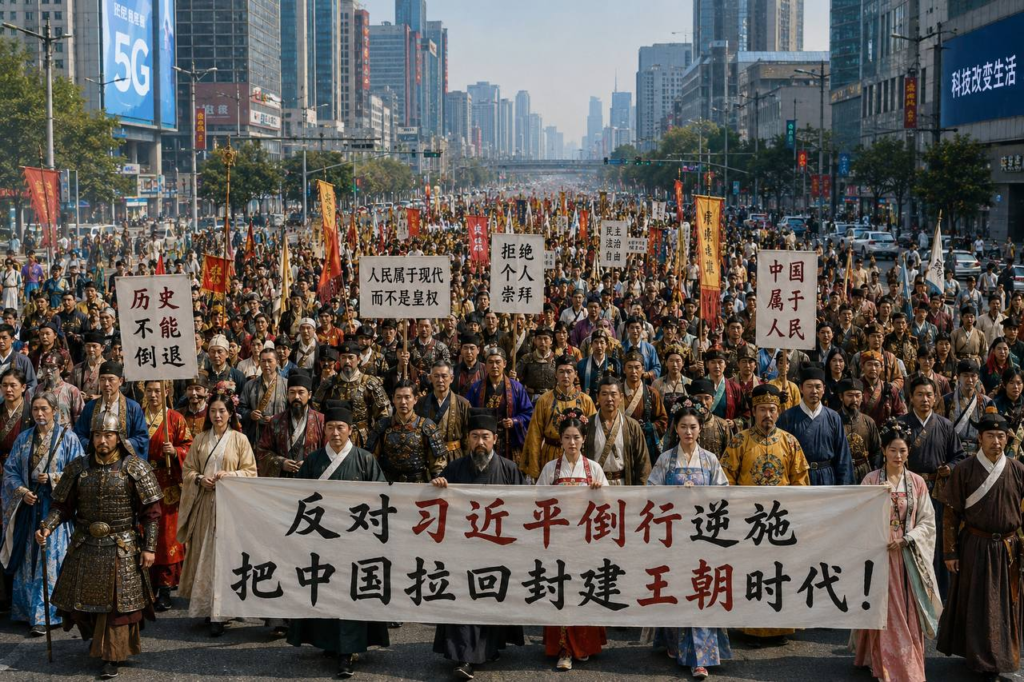
The Traditional Clothing Movement: Let History Illuminate the Future
Author: Zhao Yantao Editor: Lyu Cong
Author: Zhao Yantao
Editor: Lyu Cong
More than a century ago, Dr. Sun Yat-sen and countless heroes of the Chinese nation strove with all their might, one generation after another, to change China’s feudal system of several thousand years, and in the end led the Chinese nation out of the age of feudal dynasties and onto the road of a modern democratic republic.
They believed that the Chinese people should not live forever under imperial power, should not be merely subjects who obey orders, but should become the true masters of their country.
Yet who could have imagined that, more than a hundred years on, power would once again become highly concentrated in China, that the Chinese nation’s course of development would appear to slip backward in history, and that Xi Jinping — a criminal for the ages — would brazenly and openly set about playing the emperor once more!
The imperial ideology that was once overthrown has reappeared in another form; the personality cult that was once shattered once again influences society.
In mainland China today, people do live in better housing, possess advanced technology products, and enjoy the fruits of modern economic development.
But a truly modern country is not only modern in material terms; it must also be modern in its thinking.
If the people cannot freely express their views, cannot oversee those in power, and cannot take part in deciding the nation’s future, then no matter how advanced the technology or how prosperous the cities, their spiritual world may still remain in the closed dynastic age of the past.
Most regrettable of all, many people are still accustomed to receiving only a single source of information, accustomed to obeying authority, and even regard being ruled and restricted as a matter of course.
But history tells us that a nation’s true strength lies not only in a strong economy and strong technology; more important is that its people possess the ability to think independently and the courage to pursue freedom and dignity.
Today, I stand here dressed in the robe of a Ming dynasty official to remind everyone:
We must not forget history, nor allow history to repeat itself in a cycle.
In the past, the common people could only wait for the emperor’s decisions;
in the future, the people should decide the direction of the country.
The goals for which Dr. Sun Yat-sen and countless forebears struggled must not be forgotten.
In the end, the Chinese nation should move toward a future that is freer and more democratic, governed by the rule of law, and respectful of the people’s rights.
Finally, I hope to launch a nationwide traditional costume movement: let all the people of China put on traditional costume — from any dynasty; you can even make your own at home from bedsheets and old clothes — until Emperor Xi Jinping announces his abdication, and until the Chinese Communist Party brings its one-party dictatorship to an end!
Thank you, everyone.
More than a century ago, Dr. Sun Yat-sen and countless heroes of the Chinese nation devoted themselves to ending thousands of years of imperial rule in China. Through tremendous sacrifice and perseverance, they helped lead China out of the era of dynastic monarchy and toward the path of a modern democratic republic.
They believed that the Chinese people should not live forever under absolute imperial authority. They believed that people should not merely obey orders as subjects, but should become the true owners of their own country.
However, what few could have imagined is that more than one hundred years later, China has once again witnessed a high concentration of political power. The nation’s path appears, in some respects, to have moved backward in history. Xi Jinping, in my view, has openly assumed a role resembling that of an emperor.
Ideas of imperial authority that were once overthrown have reappeared in a different form. The cult of personality that many believed had ended has once again become influential in society.
Today’s mainland China has achieved remarkable economic development. People live in better homes, use advanced technology, and enjoy many of the benefits of modernization.
But a truly modern nation is not defined only by material prosperity. It should also be modern in its ideas, institutions, and values.
If people cannot freely express their opinions, cannot hold those in power accountable, and cannot participate in shaping the future of their country, then no matter how advanced the technology or how prosperous the cities may become, the nation’s political culture may still resemble that of an earlier imperial era.
Perhaps the greatest tragedy is that many people have become accustomed to receiving only one source of information, accustomed to obeying authority, and even believe that being ruled and restricted is simply the natural order of things.
History teaches us that a nation’s true strength is measured not only by its economy or its technological achievements, but also by whether its people possess the ability to think independently and the courage to pursue freedom, dignity, and justice.
Today, I stand here wearing the robe of a Ming Dynasty official as a reminder to everyone:
We must not forget history, and we must not allow history to repeat itself.
In the past, ordinary people could only wait for the emperor’s decisions.
In the future, the people themselves should determine the direction of their country.
The ideals that Dr. Sun Yat-sen and countless generations before us struggled for should never be forgotten.
The Chinese nation should ultimately move toward a future that is freer, more democratic, governed by the rule of law, and more respectful of the rights of its people.
Finally, I hope to launch a nationwide “Traditional Clothing Movement.” I encourage people across China to wear traditional Chinese clothing from any dynasty. Even if you do not own historical clothing, you can make your own at home using bedsheets or old clothes.
Thank you, everyone.
Finally, I would like to end with two slogans:
“Down with the Chinese Communist Party.”
“Emperor Xi Jinping, step down.”