Author: Zhao Yantao · Editor: Lu Cong
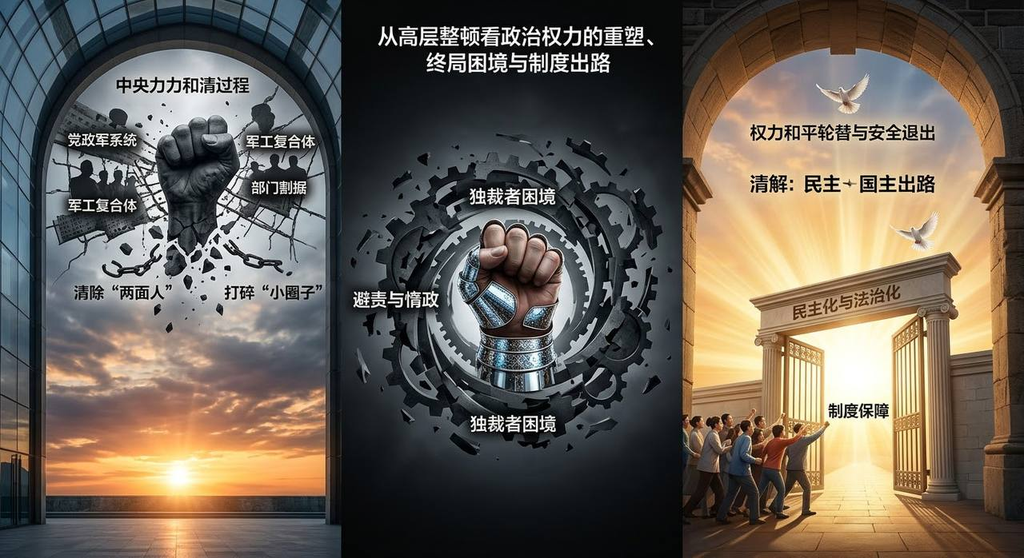
In recent years, the anti-corruption drive and the purges in the upper ranks of the CCP have followed an extremely clear political line: not only purging incumbent bureaucrats through the concentration of power, but also, more profoundly, reshaping the traditional power structure within the Party. Behind the high-pressure control, however, there also lies hidden a security dilemma endogenous to the system.
1. The Military-Industrial Sector and the Armed Forces: The Absolute Purge of the Core Forces
The field in which the purges have been most intense has consistently been concentrated in military power and the equipment departments.
Wei Fenghe and Li Shangfu: two former ministers of national defense fell from power in succession and were expelled from the Party and stripped of their rank of general; the official charges allege their involvement in the transfer of enormous interests in equipment procurement and in political disloyalty.
The Rocket Force and the senior ranks of the military-industrial sector: a number of Rocket Force generals, represented by former commander Li Yuchao, and the heads of core central state-owned enterprises such as those in aerospace technology and the ordnance industry, were investigated one after another, thoroughly reorganizing the chain of equipment research and development and procurement.
2. The Party, the Government, Foreign Affairs, and the Forces of the Elders: A Comprehensive Tightening of Discourse Power and Influence
Qin Gang: the former minister of foreign affairs was removed from office less than a year after taking up the post, in a matter involving political discipline and security compliance review.
Wen Jiabao: affected by the incident in which his family’s overseas assets were exposed, his former subordinates and his financial, political, and business networks have long been placed under strict supervision, and the “moderate reformist” line that he represented has been marginalized.
Li Keqiang and his family: after Li Keqiang’s death, the economic line he advocated and the former subordinates of the State Council system underwent large-scale personnel changes and readjustments; his family has completely faded from public view, marking the end of the political influence of the “Youth League faction” and of the elders of the preceding generation.
3. Endgame Predictions and the Security Dilemma Under the Political Purges
From the standpoint of political science theory, although continuous large-scale purges establish absolute control in the short term, in the long term they will give rise to the dictator’s dilemma:
1. Shirking of responsibility and lazy governance: because everyone in the bureaucratic system feels himself to be in danger, it falls into a generalized “inaction,” causing the mechanisms of political self-correction to fail.
2. A crisis of trust and security anxiety: after the abolition of the system of designated successors, the supreme leader faces an enormous security dilemma — the more power is concentrated, the less he dares lightly to relinquish power or withdraw, causing the system to bear extremely high structural risks at the time of a future transfer of power.
4. The Only Way Out of the Purge Cycle: Institutionalization and Democratization
How can this vicious cycle of “purge — high pressure — security dilemma” be escaped?
Reality shows that relying solely on endogenous supervision and high-pressure stability maintenance cannot bring long-lasting peace and order. The only fundamental solution for escaping the cycle of political purges lies in proactively advancing the process of democratization and rule of law in China.
1. Establish mechanisms of transparency and oversight: only by truly locking power in the cage of institutions — through judicial independence, freedom of speech, and public supervision — can the political purges launched on the basis of personal will be fundamentally replaced.
2. Guarantee the peaceful rotation of power: a democratic and rule-of-law system can provide a standardized, transparent mechanism for the transfer of power, breaking the zero-sum game in which “the winner becomes king and the loser a bandit.” This can not only bring the country long-term institutional dividends; it is also the ultimate path by which a mechanism of safe exit and political reconciliation can be provided for all participants within the system — including the supreme leader himself.