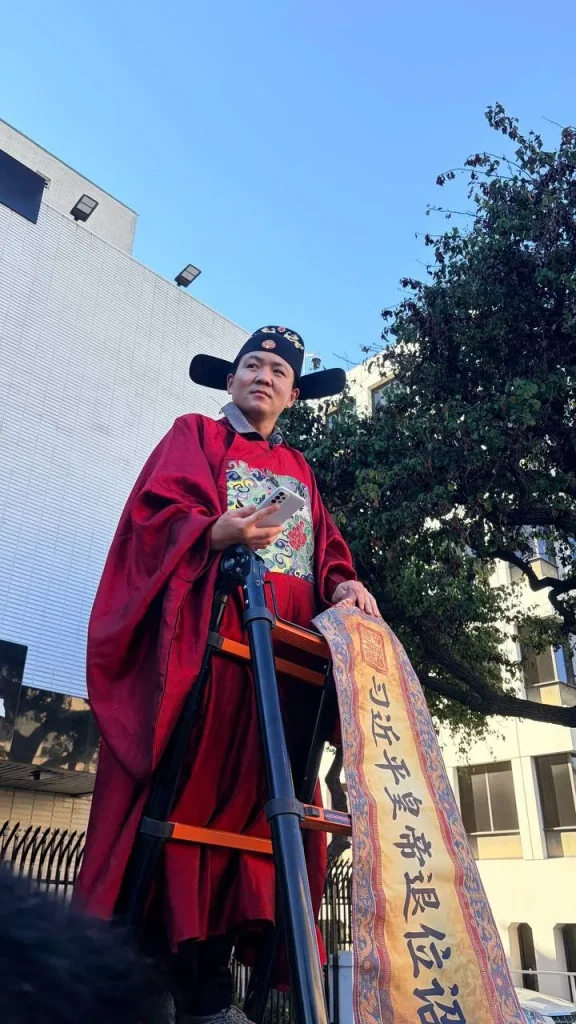
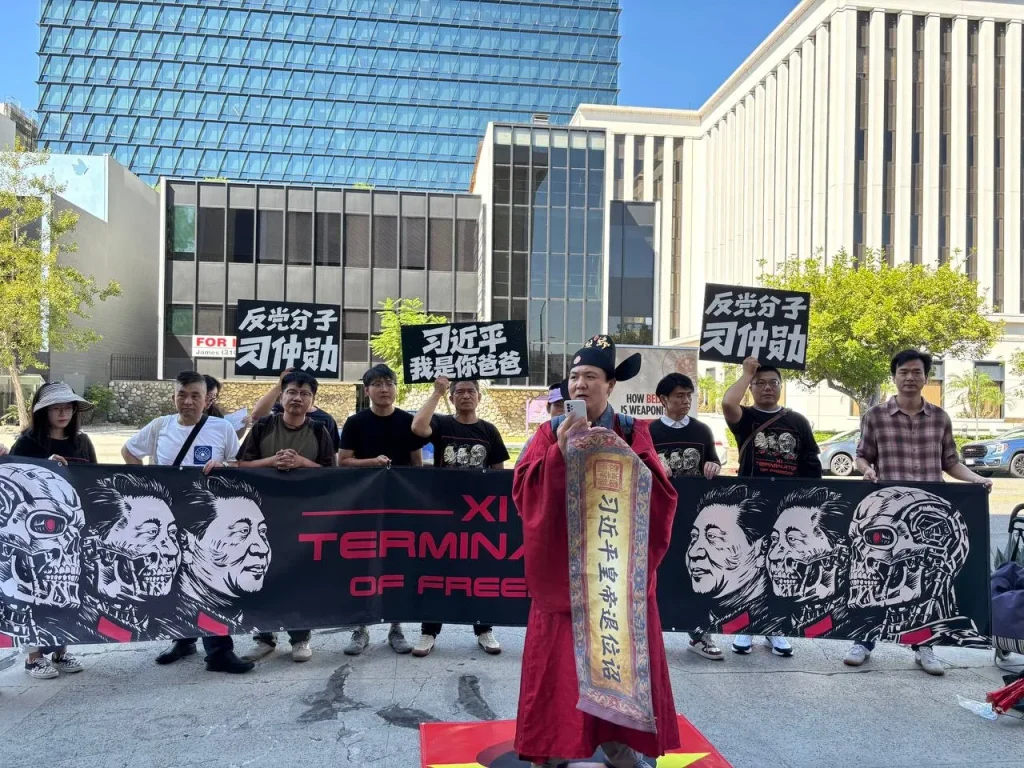
Author: Zhao Yantao Editor: Lu Cong
From the very beginning, the Chinese Traditional Costume Movement has not been a concept that exists only in slogans.
We do not merely chant slogans, nor do we merely conduct online publicity, nor merely publish articles and give speeches. We hope, rather, to bring an idea into real life, so that political expression is no longer the affair of a few, but can enter the daily lives of ordinary people through a simple, peaceful, and culturally meaningful means.
This is also where the Chinese Traditional Costume Movement differs from traditional forms of political propaganda.
1. From "Shouting It Out" to "Wearing It Out"
For a long time, public expression has often relied on writing, speeches, gatherings, slogans, and online communication.
These means are of course important, but in an age of highly fragmented information, an ordinary person's attention may last only a few seconds.
Is there, then, a form of expression that requires no lengthy discourse, yet can make a person wonder at first glance?
The answer the Chinese Traditional Costume Movement seeks to offer is:
Wear it.
If a person's life is not going well, if he is dissatisfied with reality; if he feels stifled because his speech and expression are restricted; if he cannot freely obtain information because of the internet firewall; if he feels anxious about real-world problems such as medical care and food safety; if he feels uneasy about the living environment his children will face in the future — he does not necessarily need to publish a lengthy political essay, nor does he need to stand in the street and deliver a speech.
He can put on a traditional garment.
That single garment, in itself, can become a form of expression.
Of course, a garment cannot solve real-world problems, nor can it substitute for institutional reform. But it can turn a person's attitude from a "thought in the mind" into a public symbol that can be seen.
This is the first thing the Chinese Traditional Costume Movement hopes to explore:
To let political expression change from "speaking it out" to "wearing it out."
2. Why Traditional Costume?
Some may ask: why must it be traditional Chinese costume?
Because clothing has never been merely clothing.
Throughout human history, dress has always carried functions of identity, culture, power, social rank, and the memory of an era.
This is especially true of traditional Chinese costume.
The dress of different historical periods — Hanfu, Tang-style, Song-style, and Ming-style — in itself carries rich memories of Chinese culture. When these garments appear in modern society, they naturally create a kind of "displacement in time."
And this displacement, precisely, carries expressive meaning.
When a person living in modern society suddenly walks into real life wearing a garment of historical symbolism, what others see may be not just a garment, but a question:
Why is he dressed like that today?
Once the question arises, communication has begun.
Therefore, the Chinese Traditional Costume Movement is not simply encouraging everyone to "go retro," nor is it a mere display of traditional culture.
We hope, rather, to place the symbols of traditional culture back into the modern public space, and let them become a mirror for observing reality.
3. When the "Dragon Robe" Becomes a Mirror
One of the most vivid symbols of power in ancient China is the dragon robe.
The dragon robe represents imperial power, and also a highly centralized order of power.
And today, when historical symbols such as the "emperor" and the "dragon robe" are once again used for political expression, traditional costume can produce a very interesting effect of irony:
When power once again drapes itself in the garments symbolizing imperial authority, ordinary people can also use clothing as a mirror with which to answer it.
We do not need to contend with it for the "dragon robe."
We do not even need to shout many slogans aloud.
We need only put on our own traditional costume, and let this cultural symbol form a contrast with reality.
And so, the clothing begins to speak:
"Look — someone is turning back the wheel of history."
This may be the most central visual logic of the Chinese Traditional Costume Movement.
It is not to answer violence with violence, but to answer symbols with symbols; not to replace an old myth of power with another myth of power, but, through cultural irony, to make people rethink the relationship among power, history, and citizens.
4. From One Person's Expression to a Group's Action
Any social movement, if it forever remains at the level of online articles and slogans, will find it hard to truly enter reality.
Therefore, the Chinese Traditional Costume Movement emphasizes "action."
The action spoken of here does not mean violence, nor does it mean destruction.
It can be very simple.
A person going to work can wear traditional costume.
A person attending a cultural event can wear traditional costume.
A person going to a public place can wear traditional costume.
A group of friends gathering together can wear traditional costume.
Attending a peaceful expression activity, one can also wear traditional costume.
Even an ordinary person who merely takes a photograph or records a video and shares his traditional costume on social media can become part of this form of cultural expression.
When one person's action becomes the action of ten people, ten become a hundred, and a hundred become a thousand, a symbol that was once unfamiliar may gradually take shape in society's awareness.
This is the logic of communication in the age of new media:
It is not to wait for others to speak for us, but to let every person become a communicator.
5. What Do We Truly Hope to Spread?
What the Chinese Traditional Costume Movement spreads is not any particular garment itself.
What we truly hope to spread is a way of thinking:
What kind of citizens should the Chinese people ultimately become?
Traditional costume is only the vehicle.
The questions behind the clothing are the questions we truly care about.
We hope people will rethink the relationship between the individual and power, and rethink freedom, dignity, the rule of law, public participation, and personal responsibility.
We also hope that traditional culture will no longer be merely a historical specimen in a museum, nor merely a visual element in films and television dramas, but can become a cultural language within modern society.
Traditional culture can be beautiful.
It can also be thoughtful.
And it can also take part in public discussion.
If a traditional garment can make a young person begin, for the first time, to think about "what is a citizen," "what is power," and "what is freedom," then it has already gone beyond the meaning of an ordinary garment.
6. Real Action Need Not Be Earth-Shaking
Many people believe that change must be a grand, earth-shaking undertaking.
But many important social changes in history began, at the very start, as a very small act.
One person refuses to be silent.
One person begins to ask questions.
One person begins to read.
One person begins to express himself.
One person begins to refuse to take certain things for granted.
Then a second person appears.
A third person appears.
In the end, individual action forms a public consciousness.
What the Chinese Traditional Costume Movement hopes to do is precisely to begin with a very simple action:
Wear it.
You do not need to become a politician.
You do not need to become an opinion leader.
You do not need to have a large number of followers.
You do not even need to publish a long essay.
If you identify with this form of expression, then a traditional garment is a public language you can choose to use.
7. Let Clothing Become a Mirror
We do not believe that a garment can solve all problems.
Medical problems will not disappear because of a garment; food safety will not change because of a garment; information barriers will not automatically vanish because of a garment.
But the formation of public consciousness was never accomplished by a single thing.
It requires the thinking, expression, and action of countless people.
What the Chinese Traditional Costume Movement does is to try to add a new form of expression:
Let culture become the language of political expression, let clothing become a medium of public discussion, and let ordinary people possess a simple and peaceful way to act.
We wear the dress of ancient times not because we want to return to ancient times.
Quite the opposite.
Precisely because we do not want to return to the past, we wear the past upon ourselves, and let it become a mirror for today.
When someone once again drapes himself in the "dragon robe," we put on our own traditional costume.
When power tries to turn history into myth, we use history to remind reality.
When someone tries to make society forget the past, we let culture become memory.
In the end, we hope the clothing speaks for itself:
"Look — someone is turning back the wheel of history."
And what we must do is keep moving forward.
Clothing is not just clothing.
When it becomes a mirror, it can reflect the times.
This, perhaps, is the meaning the Chinese Traditional Costume Movement truly seeks to explore.