Author: Zhao Yantao Editor: Lü Cong
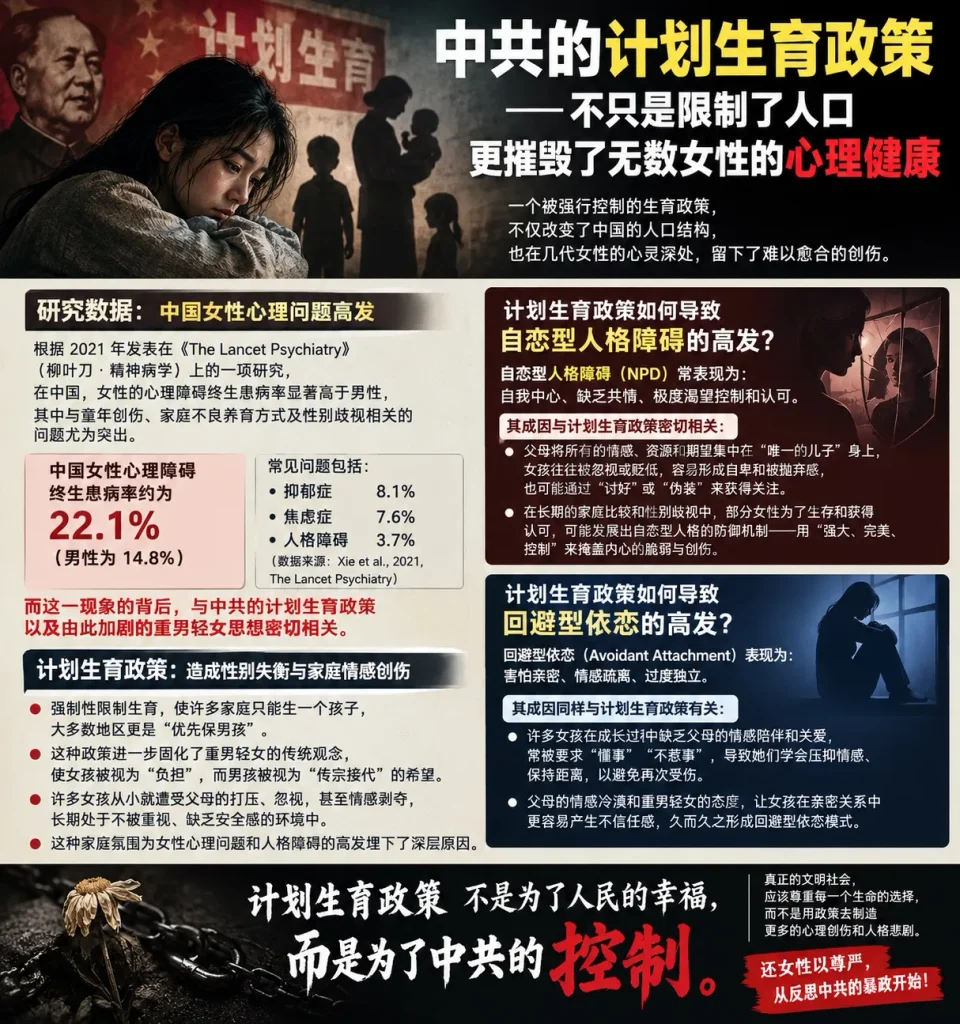
The CCP's family planning policy not only deprived countless families of the right to decide childbearing for themselves; under the influence of the traditional preference for sons over daughters, it also aggravated gender discrimination and emotional harm within some families. The consequences of this policy should not be measured by population structure and birth rate alone; they should also be reflected upon from the perspectives of women's dignity, family relationships, and intergenerational psychological trauma.
I. The Preference for Sons over Daughters: Why Do Girls Become the Victims?
In a China where traditional attitudes are deeply rooted, when the state strictly restricts childbearing, and when some parents are fixated on having sons, girls may become the ones who bear the family's disappointment and prejudice.
From childhood on, they may suffer coldness, belittlement, and emotional neglect, and may even be required to prove their worth through better grades and more compliant behavior. The message they may receive is: boys are by nature more worthy of expectation, while girls must give more in order to obtain the same love.
Such an environment can destroy a person's sense of security, causing them, as they grow up, to gradually form psychological patterns of low self-esteem, excessive defensiveness, fear of rejection, or difficulty in trusting others.
II. NPD: When Self-Worth Is Built on Control and Recognition
Narcissistic Personality Disorder (NPD) involves complex mechanisms of psychological development.
Being belittled, emotionally neglected, or conditionally accepted over a long period can affect a person's sense of self-worth and their interpersonal relationships. Some people may protect their fragile self-esteem by pursuing perfection, craving recognition from the outside world, being unable to accept criticism, or attempting to control others.
In an environment of prolonged repression and unfairness at home, children may gradually develop distorted means of self-protection: some constantly try to please others, some strive desperately to prove themselves, and some seek a sense of superiority by belittling or controlling others.
When a society tolerates gender discrimination, and lets children grow up from childhood under unequal expectations, we cannot ignore the long-term psychological costs that such an upbringing may exact.
III. Avoidant Attachment: When a Person No Longer Believes in Love
Avoidant attachment may manifest itself as a fear of depending on others, the suppression of emotions, the avoidance of intimate relationships, and a habit of enduring suffering alone.
When children meet coldness when they express their needs, blame when they seek comfort, and neglect of their feelings over a long period, they may gradually learn to stop expressing vulnerability, to stop expecting to be understood, and even to turn emotional independence into a wall that shields them.
In adulthood, they may long for intimacy yet fear drawing truly close; hope to receive care yet not dare to trust easily; and, when facing conflict, tend toward silence, distance, or avoidance.
This psychological pattern is not the exclusive product of any one policy; but in an environment where family planning restrictions, the preference for sons over daughters, and emotional neglect within the family are layered upon one another, the pressure borne by some girls, and its long-term effects, deserve society's serious attention.
IV. Research Evidence: The Mental-Health Costs Inflicted by the Policy
A study published in BMJ Open in 2021 explored the relationship between the loss of an only child and depression among women in the context of China's family planning, revealing an association, worthy of attention, between such family experiences and mental-health problems.
Reference: Full text of the BMJ Open study
The historical costs of the family planning policy are reflected not only in changes to the population structure, but also in the restriction of reproductive autonomy, the intensification of family stress, and the lasting harm that traditional gender attitudes may inflict on women.
V. What the CCP's Family Planning Policy Has Left Behind Is Not Only a Population Problem
When state power intrudes into a family's childbearing choices, when the preference for sons over daughters decides how a child is treated, and when emotional neglect becomes a constant in the upbringing of some girls, what is affected may be not only a person's childhood, but also their self-identity, intimate relationships, and family life in adulthood.
These traumas may also be passed on to the next generation through family interaction, so that former victims, lacking support, repeat the relationship patterns familiar to them.
We must not allow these historical costs to be forgotten.
The lesson left behind by the CCP's family planning policy is that no regime should govern society at the cost of controlling people's freedom of childbearing. Women are not tools of reproduction, children are not tools for carrying on the family line, and a person's worth should all the less be determined by gender.
To reflect on this history is to ensure that everyone possesses reproductive autonomy and personal dignity, and the freedom of not having to exchange obedience and sacrifice for love.