Author: Zhao Yantao Editor: Lü Cong
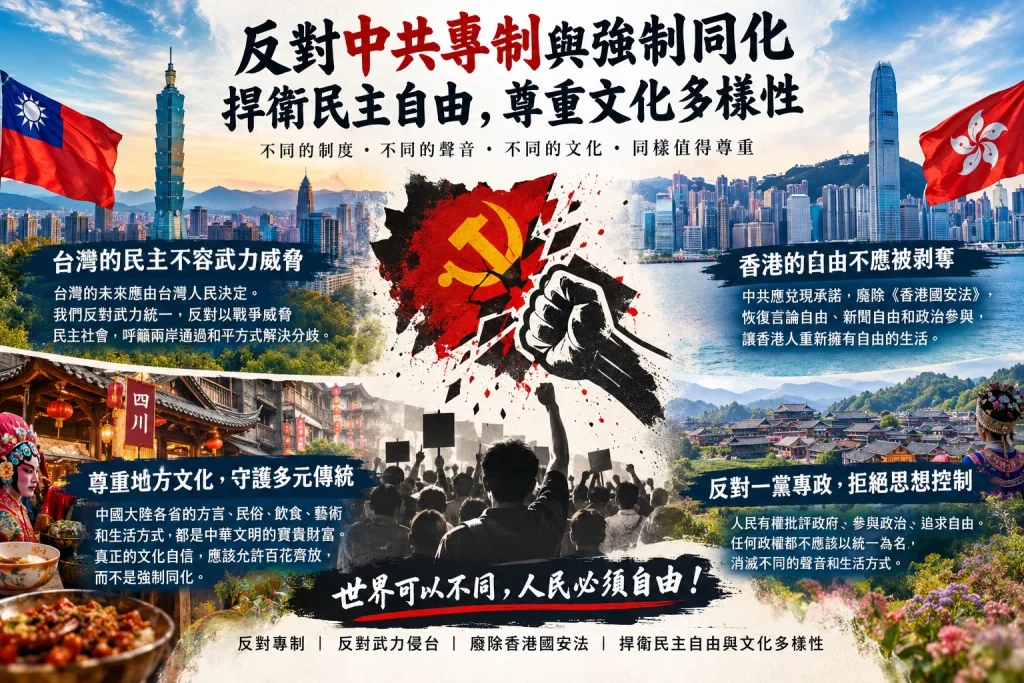
A society that truly respects its people should allow different voices, different systems, and different cultures to coexist.
For a long time, the CCP has regarded political unity, ideological unity, and the concentration of power as important goals of governance. Yet when unity becomes an overriding political principle, when dissenting views are treated as threats, and when cultural differences are required to submit to a single national narrative, we must ask: is this unity, purchased at the price of eliminating differences, truly for the well-being of the people, or is it for maintaining the grip of power?
I. Oppose One-Party Dictatorship, Defend the People's Political Rights
The CCP practices one-party rule and lacks a multiparty democratic system in which central power can change hands through free competition. Political power is highly concentrated, and the space for the people to express political demands, oversee the government, and participate in public affairs is restricted.
A society's stability should not be built on the people's fear of speaking; a government's authority should not depend on the suppression of different voices.
The people have the right to criticize the government, the right to discuss the nation's future, and the right to demand that power be constrained by law and institutions. Democracy, freedom of speech, and political participation should not be favors that rulers may bestow at will; they should be fundamental rights that the people enjoy and that are guaranteed to them.
To oppose the CCP's one-party dictatorship is precisely to demand that political power submit to the people's supervision, so that citizens may enjoy fuller freedom and the right to choose.
II. Taiwan Is Not a Tool for the CCP to Realize Its Political Ambitions
Taiwan has its own democratically elected government, democratic system, and way of social life. How Taiwan's future should develop must respect the will of the Taiwanese people.
The CCP has long adhered to the goal of unification and has not renounced the option of using force against Taiwan. This military threat poses a persistent risk to peace in the Taiwan Strait, and it subjects ordinary people on both sides to unnecessary fear and uncertainty.
No political claim should become a justification for launching a war, threatening civilians, or depriving others of their right to political choice.
Historical ties do not amount to an unlimited right of political domination, and national identity does not mean that one society must accept the rule of another regime.
Taiwan's future should be decided by the people of Taiwan. We oppose unification by force, oppose threatening a democratic society with war, and call on the two sides of the Strait to resolve their differences by peaceful means.
What is truly worth pursuing is enabling people living under different systems to coexist in peace — not allowing one political system to eliminate another through military force.
III. Hong Kong's Freedom Should Not Become a Sacrifice to Political Promises
Hong Kong once possessed a distinctive legal system, social environment, and international connections. Hong Kong's historical development formed social characteristics distinct from those of mainland China, and led many people to hold expectations for its high degree of autonomy and its guarantees of freedom.
However, since the Hong Kong National Security Law came into force in 2020, Hong Kong's political environment, space for public expression, and democratic development have been profoundly affected. Supporters of the law emphasize national security and social stability, while critics focus on its restrictions on freedom of speech, freedom of the press, and political participation.
We must face these controversies squarely and demand that the fundamental rights of the people of Hong Kong be effectively guaranteed.
The CCP should honor its commitments regarding Hong Kong's original system and way of life. We call for the repeal of the Hong Kong National Security Law, and for the restoration of fuller freedom of speech, freedom of the press, political participation, and civil rights, so that Hong Kong society can once again have the space to discuss public affairs openly.
If a government asks the people to believe its promises, it must accept the people's scrutiny of its actual conduct.
IV. Oppose Forced Assimilation, Protect the Cultural Traditions of All Parts of China
The political grand unification pursued by the CCP concerns not only the structure of power, but also national identity, historical narrative, and cultural expression.
Mainland China possesses rich and diverse regional cultures. Guangdong, Sichuan, Fujian, Yunnan, and other regions each have their own dialects, folk customs, cuisines, arts, and living traditions. Together, these cultures make up the complex face of Chinese civilization.
Cultural diversity should not be treated as a nuisance to governance, still less should it be compressed in order to forge a single political identity.
Dialects deserve to be passed down, traditional customs deserve protection, and local histories deserve study. No local culture should be regarded as backward or as an object in need of change merely because it differs from the mainstream political narrative.
True cultural confidence is the capacity to respect differences; true development of civilization is to give different traditions the room to keep growing.
The more mature a society is, the more it can accommodate different ways of life. Conversely, if a regime is always trying to dictate how the people should think, how they should express themselves, and how they should identify with their own history, then what it maintains is not only unity, but also a form of control over society.
V. When Political Power Tries to Change Everything, Society Must Hold Fast to the Boundaries of Freedom
A political logic that constantly demands that others submit to it, changes the systems of others, and eliminates the differences of others is like an ever-expanding force, seeking to intrude into every corner of social life.
This logic is cause for concern, because it places the expansion of power above individual freedom, superficial uniformity above genuine diversity, and political obedience above the autonomy of citizens.
When everyone is required to say the same things, accept the same narrative, and obey the same political will, society gradually loses its ability to correct itself.
People who criticize the government may find themselves ostracized, minority views may lose their space for expression, and local traditions may gradually vanish under the pressure of homogenization.
Therefore, we must clearly draw the boundaries of political power: a government may govern public affairs, but it must not monopolize thought; a state may maintain public order, but it must not use that as a pretext to compress citizens' freedoms without limit; a society may pursue common goals, but it must not require everyone to give up their own culture and judgment.
Conclusion: The World Does Not Need Everyone to Become the Same
Taiwan's democracy, Hong Kong's freedom, and the cultural traditions of various parts of mainland China may appear to belong to different domains, but in fact they all point to the same core question: Do the people have the right to preserve their own choices? Does society have the capacity to accommodate differences? Are there boundaries that political power must not cross?
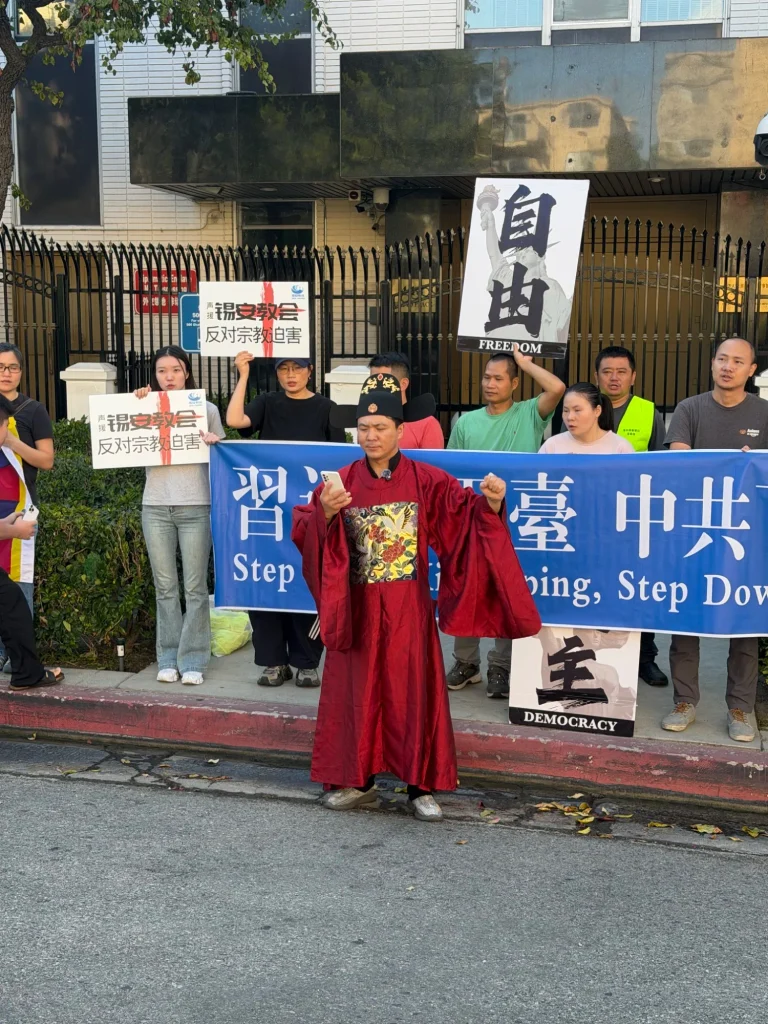
We oppose the CCP's one-party dictatorship, oppose threatening Taiwan with force, demand the restoration of democracy and freedom in Hong Kong, and oppose compressing the living space of local cultures in the name of political unification.
We hope that mainland China can move toward a more open society, where the people enjoy the freedom to express their opinions, participate in politics, and choose their way of life, and where the traditional cultures of different regions receive genuine protection.
The world was never meant to have only one voice, one system, or one culture.
Taiwan's democracy should not be threatened by force, Hong Kong's freedom should not be subjected to political suppression, and the traditions of all parts of China should not be forcibly assimilated.
Oppose despotism, defend freedom; respect differences, reject forced assimilation.
This is not only a reflection on the future of Taiwan, Hong Kong, and mainland China; it is also a commitment to the common values of humanity.